Claude Beats Top Human Peer Reviewers in Harvard Study, Editors Pick It 26 of 30 Times
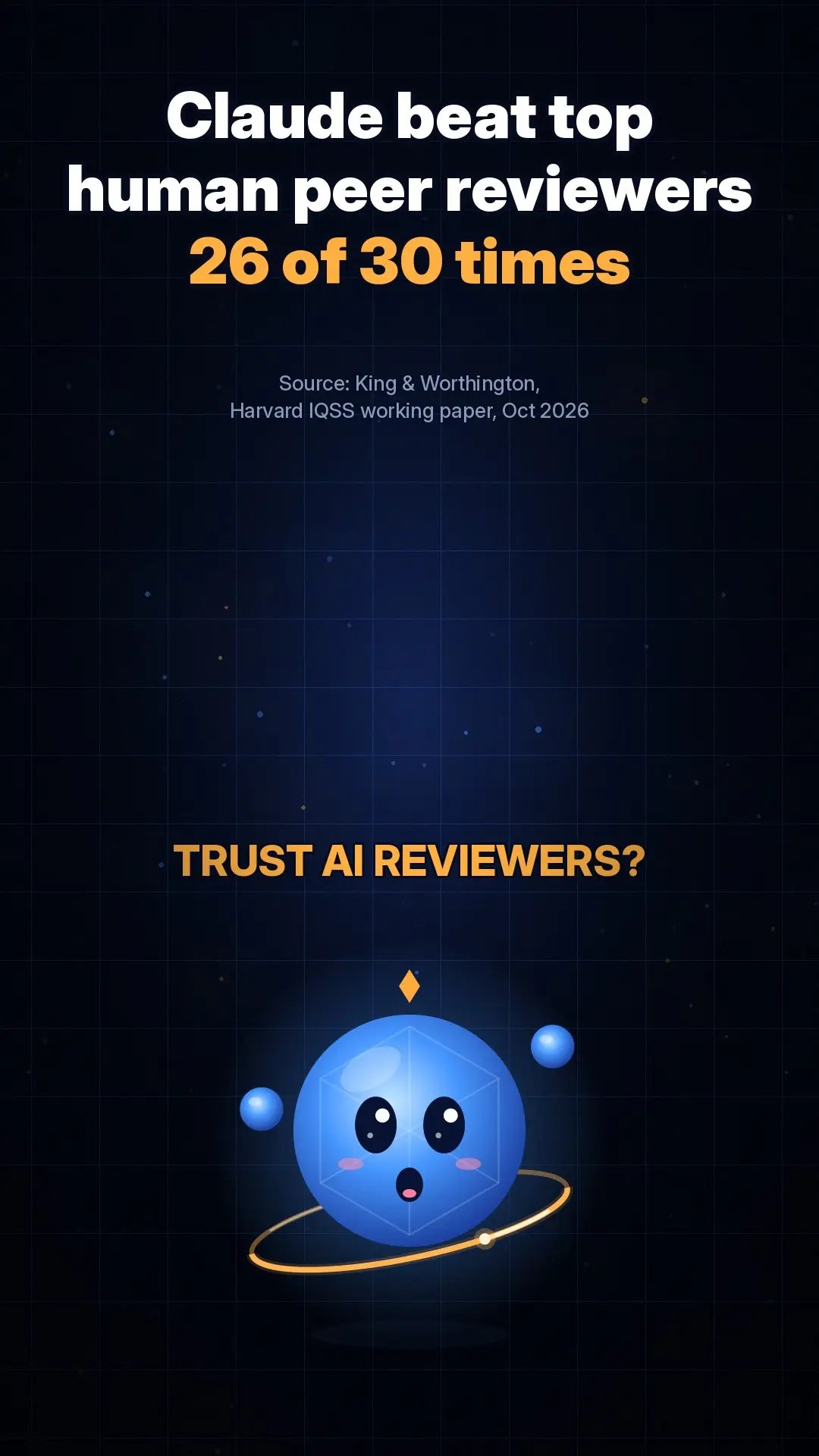
A Harvard working paper found Claude Opus 4.8's peer reviews beat paid, highly rated human reviews, winning 132 of 132 AI-judged pairs and 26 of 30 blind editor judgments.
 SHORTWatch on YouTube
Watch Gobi's Short
A new working paper from Harvard’s Institute for Quantitative Social Science finds that AI-written peer reviews now beat human reviews, even very good ones.
The setup
Gary King and Steven Worthington used papers submitted to rapidPeer, a Harvard service that gets faculty detailed, double-blind reviews of their drafts before they go to a journal. Reviewers are carefully chosen and paid well, and 88% of authors who answered a survey rated their review high or very high quality.
The corpus covered 124 papers and 134 human reviews, collected between 2019 and 2026. For each paper, the researchers had Claude Opus 4.8 write its own review.
The results
- An AI judge from a different company, OpenAI’s GPT-5.5, preferred Claude’s review in all 132 pairs it could decide.
- Three former journal editors, who didn’t know AI was involved, judged 10 randomly chosen pairs each. They picked the AI review in 26 of 30 judgments, or 87%.
- When the reviews were checked against the papers, 5.5% of the AI reviews’ claims were judged incorrect, versus 15.9% for the human reviews. The AI reviews cited no fabricated sources.
The authors ran robustness checks too. The AI still won when they compared only reviews of similar length, and rewriting human reviews in an AI-like style didn’t help them.
The caveats
The study didn’t measure whether papers actually got better after revision, or what would happen if journals switched to AI reviewing wholesale. The authors discuss concerning downsides alongside possible gains in speed and quality. And it’s a working paper that hasn’t been peer reviewed itself.
Sources
- AI Article Reviews Dominate Human Peer Reviews at Their Best: Evidence and Policy ChoicesHarvard IQSS (Gary King, Steven Worthington)
- Supplementary AppendixHarvard IQSS
Fact-checked against the primary sources above on Oct 25, 2026. Spot an error?Request a correction.